Randolph Driblette
The Crying of Lot 49Randolph Driblette is the director and actor whose production of The Courier’s Tragedy draws Oedipa Maas into a closer investigation of Trystero. As Gennaro, the play’s surviving administrator, he gives a performance that departs from the surviving text: he puts the three assassins onstage and speaks lines that include the name Trystero. He maintains that a play lives in the performer’s mind and on the stage, not solely in a book. His later suicide, shortly after the production closes, leaves Oedipa grieving for a guide she cannot recover or fully understand.
Identity and Introduction
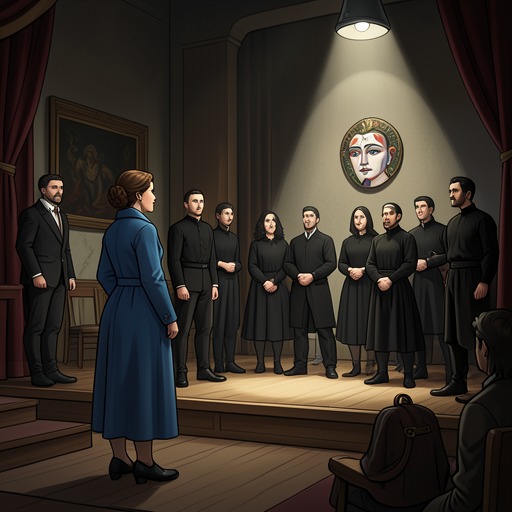
The program identifies Driblette as the director of The Courier’s Tragedy and the actor playing Gennaro, the winner who remains alive after the fifth act’s succession of violent deaths. The play ends in an anticlimactic bloodbath at the court of Squamuglia, with Gennaro nearly the only character left standing. This pairing of director and leading actor matters to Oedipa: Driblette is not merely an authority she might consult about the text but the person who has shaped the performance she has just seen.
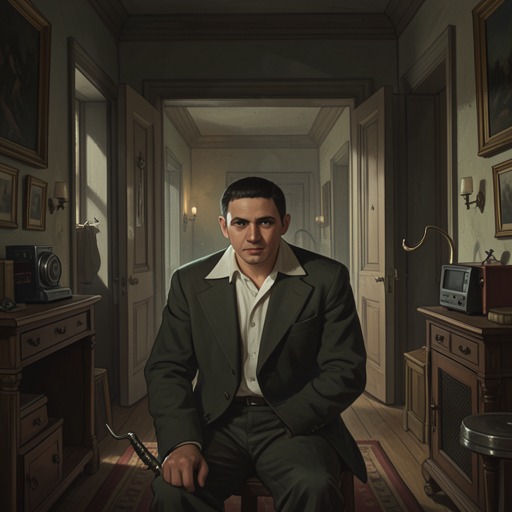
After the performance, Oedipa decides to find Driblette and ask whether there is a connection between the play and her emerging suspicions about Trystero. She searches the theater’s circular corridor, enters the dressing-room area, and eventually finds him still in Gennaro’s gray flannel costume. Their meeting begins as an attempt to ask about the play, but his answers become an argument about where its meaning resides.
Performance and Interpretation
Driblette discourages Oedipa from treating the production as a coded literary document. He describes the play as entertainment rather than literature and resists being drawn into what he sees as scholarly disputes over words. Yet his own staging has introduced material that makes textual certainty difficult: he says he added the knowing look shared by the cast when the Trystero assassins are mentioned, and brought the three assassins onstage in the fourth act even though Wharfinger’s script did not show them.
For Driblette, those changes are not errors to be judged against a definitive printed script. He argues that the play exists in his mind and that his work is to give its spirit a body. Words, in this account, are prompts that carry the actor toward an imagined theatrical world; the stage’s visible and audible reality comes through the performer. His claim gives performance creative authority, but it also frustrates Oedipa’s search for evidence: if the production’s details originate in Driblette’s interpretation, they cannot automatically establish what Wharfinger wrote or what Trystero means.
The disagreement becomes especially charged when Oedipa asks why he treated Trystero differently from Wharfinger. Driblette’s face disappears from view as he withdraws into the steam, and he speculates that if he vanished, the version of the play he had made would vanish too. What might remain, he suggests, would be historical traces—Squamuglia and Faggio, the Thurn and Taxis mail system, and perhaps the Adversary—but traces would not preserve the living theatrical world he had created. His reflection foreshadows the way his death will make Oedipa’s access to that world uncertain.
Death and Oedipa’s Loss
After returning to the Tank Theatre, Oedipa tries to call Driblette and learns from his mother that the family will issue a statement. She later discovers the truth at a gathering at Emory Bortz’s home: Driblette walked into the Pacific two nights earlier, wearing his Gennaro costume. Bortz says the suicide came just after the set of The Courier’s Tragedy had been struck. The costume connects the death to the role through which Oedipa first sought him, while the timing places it immediately after the production’s theatrical world has ended.
Oedipa responds not only with shock but with a sense that people who had linked her to different parts of her life and investigation are disappearing. She remembers Driblette as her best guide back to Trystero and wonders whether some version of herself has vanished with him, as he had once suggested could happen if his imagined world disappeared. At his burial, she listens to his younger brother’s eulogy, watches his mother mourn, and later sits at the grave with Bortz, Grace, and the graduate students. She wonders whether Driblette’s death had anything to do with Trystero, but the evidence cannot answer her.
The Unresolved Script and Mystery
At Bortz’s home, Oedipa compares what she heard in the theater with the textual versions Bortz knows. Bortz recites the couplet he associates with the end of the fourth act and says that, in his preferred text, the final line of another couplet is suppressed; he calls the Vatican book an obscene parody and the Whitechapel version corrupt. He considers Driblette’s omission of the doubtful passage a sound choice. Oedipa insists, however, that Driblette did use the Vatican lines that night, including the word Trystero. Bortz replies that the choice was Driblette’s as both director and actor, without explaining why he made it.
The disagreement leaves Oedipa with a decisive but incomplete fact: Driblette’s performance included a Trystero reference that cannot be explained simply by appealing to the printed text or to a settled authorial intention. Yet neither Bortz nor Oedipa can say whether the addition was whim, interpretation, or something connected to the mystery. Oedipa imagines that changing the script and walking into the sea may have arisen from the same unknowable mix of circumstances, but she cannot confirm that conjecture. She calls for Driblette in her thoughts and receives no answer; as with Maxwell’s Demon, she cannot know whether communication has failed or whether there is no one there to answer. His absence thus sharpens the novel’s uncertainty: the performance survives as a clue, while its maker cannot explain it.